
Introduction
Launching a SaaS or Tech startup is often about solving a real-world problem with a smart product. But after the product is ready, a bigger challenge begins: how do you get customers at scale?
This is where Growth Marketing comes in. Unlike traditional marketing, growth marketing focuses on building repeatable, scalable, and data-driven processes that attract, engage, convert, and retain customers.
If you’re a founder with little or no marketing experience, this guide will give you a step-by-step foundation to start building your growth engine.
“Good marketing makes the company look smart. Great marketing makes the customer feel smart.”
– Joe Chernov, via Salesforce Marketing Quotes
What is Growth Marketing?
Growth marketing is the data-driven evolution of traditional marketing. Instead of focusing only on awareness or brand campaigns, it blends marketing, product, and analytics to continuously test, learn, and scale what works.
Definition: Growth Marketing is the systematic process of attracting, engaging, converting, and retaining customers through a combination of marketing strategies, data analysis, and product improvements.


79% of companies prioritize growth marketing over traditional campaigns.
Why SaaS & Tech Founders Need Growth Marketing
Most SaaS and Tech founding teams include engineers, finance experts, or industry specialists — but rarely marketers. Without structured growth, even a great product risks being invisible.
Market Opportunity
Global SaaS market projected to hit $716.5B by 2028.
Challenge
90% of startups fail, and lack of customer acquisition is a top reason.
Solution
Growth marketing provides repeatable processes for consistent lead generation and revenue.
Key Differences: Growth Marketing vs. Traditional Marketing
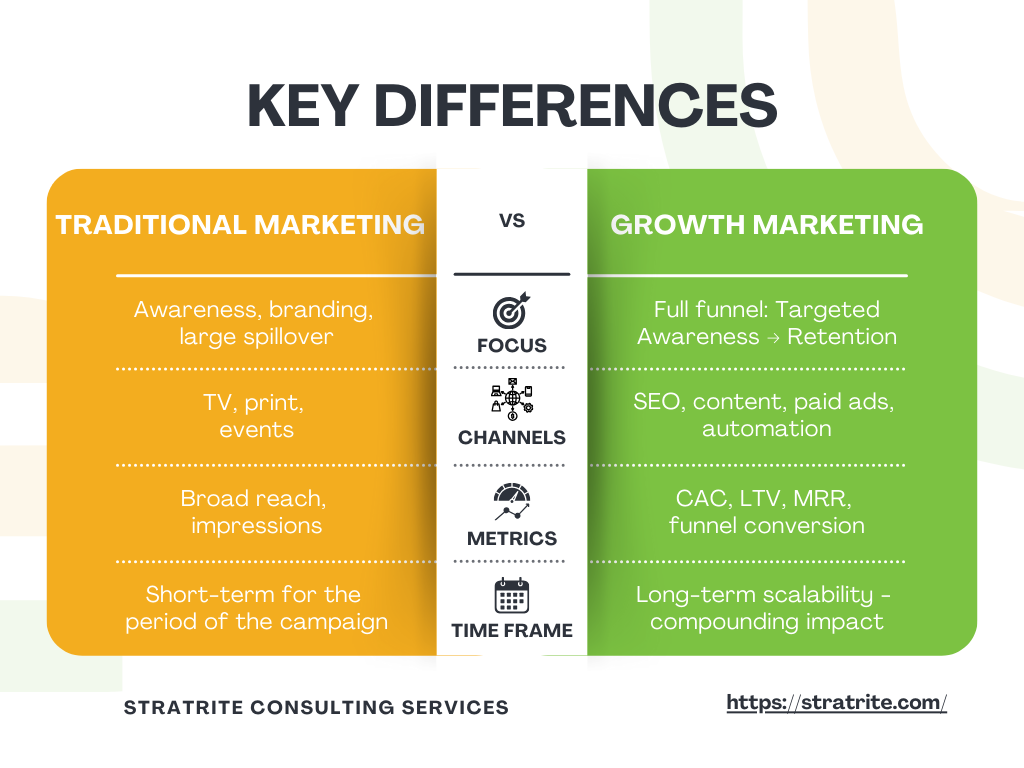
While traditional marketing focuses on broad campaigns aimed at building brand awareness and driving immediate sales, growth marketing takes a more agile and data-driven approach. Growth marketing emphasizes experimentation, personalization, and full-funnel optimization to achieve sustainable, long-term growth. Unlike traditional strategies that rely heavily on one-way messaging and fixed budgets, growth marketing continuously tests, measures, and adapts to maximize ROI and customer lifetime value.
The Funnel for Growth
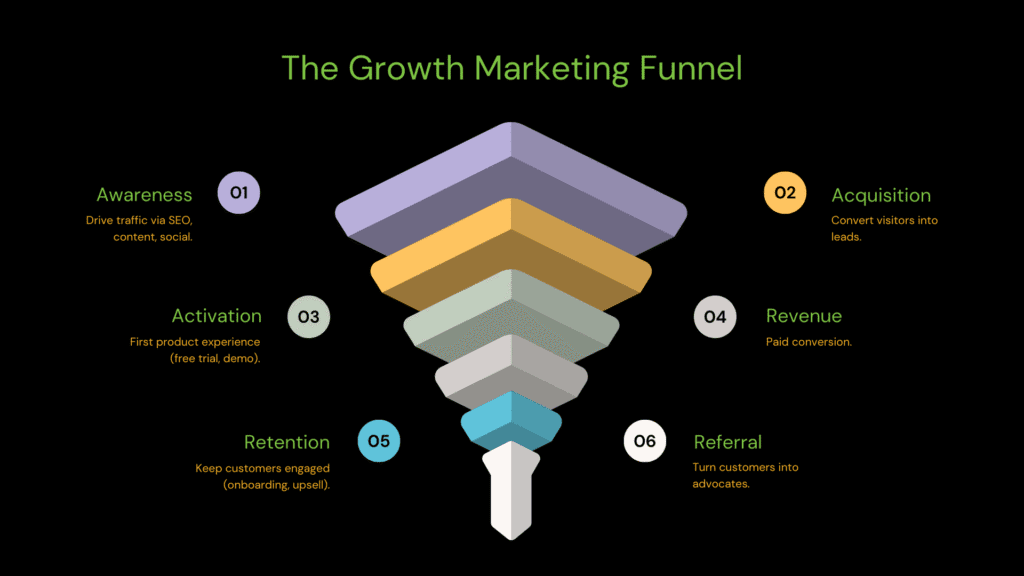
The growth marketing funnel goes beyond the classic awareness-to-purchase journey. It focuses on the entire customer lifecycle, from attracting and engaging prospects to retaining customers and turning them into advocates. Unlike traditional funnels that stop at conversion, the growth funnel emphasizes stages like activation, retention, referral, and revenue optimization. This holistic approach ensures that every interaction adds value, creating compounding growth over time.
Tip for Founders: Even if you have no marketing background, start by mapping your customer journey across this funnel.
Step-by-Step: How to Start Growth Marketing as a Founder
Define Your ICP (Ideal Customer Profile)
Who exactly are you targeting? Define industry, company size, job titles.
Set Measurable Goals
Example: “Generate 100 qualified leads in 3 months.”
Pick Early Channels
For SaaS: SEO, LinkedIn, Email automation are cost-efficient.
Build a Website That Converts
Landing pages, CTAs, lead magnets.
Invest in Content & SEO
Blogs, guides, and FAQs are compounding assets.
Test & Measure
Track CAC (Customer Acquisition Cost), LTV (Lifetime Value), MQL→SQL conversion.
Automate Early
Use tools like HubSpot, Zoho, or Mailchimp to nurture leads automatically.
Real-World Examples
- Dropbox: Used referral programs (extra storage for sharing) → grew from 100K users to 4M in 15 months.
- Slack: Focused on onboarding experience → achieved 30% MoM growth in early days.
Both are growth marketing playbooks in action: data + product + marketing working together.
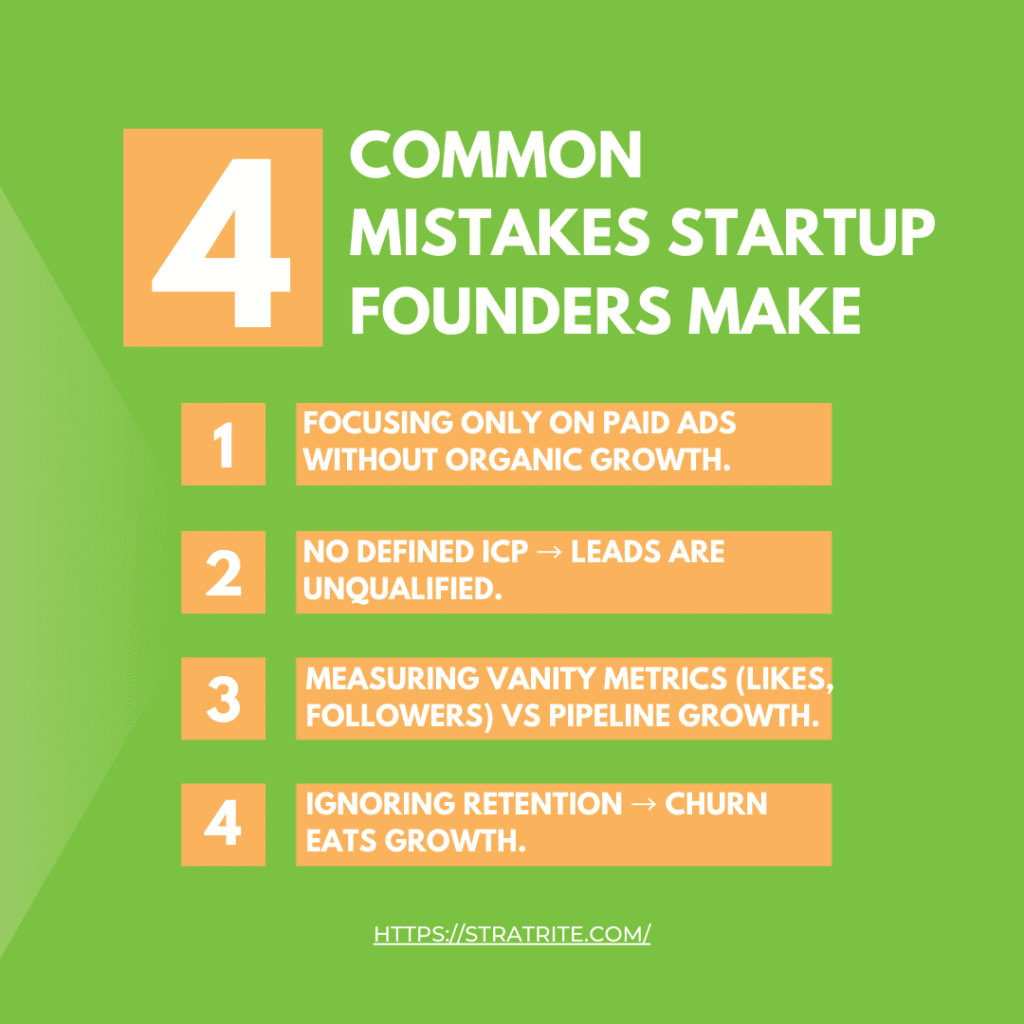
Common Mistakes Founders Make
To Clarify..
Is growth marketing the same as digital marketing?
No. Digital marketing focuses on channels (SEO, ads, social). Growth marketing spans full customer lifecycle.
How is growth marketing different from growth hacking?
Growth hacking is short-term, experimental. Growth marketing is structured, repeatable, and sustainable.
Do early-stage SaaS startups need growth marketing?
Yes. Even before Series A, founders need a basic growth engine to validate product-market fit and reduce CAC.
Final thoughts
Growth marketing isn’t just another buzzword. For SaaS and Tech founders, it’s the missing discipline that ensures your product actually reaches the right audience — and keeps them coming back.
The best part? You don’t need to be a marketer to get started. By following structured steps, leveraging data, and focusing on your customer journey, you can begin building a growth engine today.
Frequently Asked Questions
What is growth marketing in simple terms?
Growth marketing is a data-driven approach that focuses on attracting, converting, and retaining customers across the entire funnel, not just awareness.
Why is growth marketing important for SaaS startups?
It helps SaaS founders build repeatable lead pipelines, reduce customer acquisition costs (CAC), and drive long-term customer retention.
What is the difference between growth marketing and digital marketing?
Digital marketing is channel-focused (SEO, ads, social), while growth marketing spans the entire customer lifecycle from awareness to retention and referral.
How is growth marketing different from growth hacking?
Growth hacking is about short-term quick experiments, while growth marketing builds sustainable, repeatable growth systems.
What are the key elements of a growth marketing funnel?
Awareness → Acquisition → Activation → Revenue → Retention → Referral. Each stage has its own strategies and KPIs.
Can non-marketer founders start growth marketing on their own?
Yes. Even without a marketing team, founders can start with ICP definition, content, SEO, and automation tools before scaling.
Ready to build your growth engine?
Take your first step towards scalable growth.