
Introduction
You’ve built a great product. But how do you take it to the market, win customers, and scale revenue?
That’s the role of a Go-To-Market (GTM) strategy.
For SaaS and Tech founders, especially those without a marketing background, GTM can seem overwhelming. This guide breaks GTM into a practical, step-by-step framework so you can launch confidently, avoid costly mistakes, and build a scalable growth engine.
“Strategy without tactics is the slowest route to victory. Tactics without strategy is the noise before defeat.”
– Sun Tzu, The Art of War
What is a Go-To-Market (GTM) Strategy?
A GTM strategy is a comprehensive plan for how a business introduces a product or service to the market and ensures it gains traction.
It answers critical questions:
Who are we selling to?
What problem are we solving?
How do we differentiate from competitors?
Which channels will we use to reach customers?
How do we measure success?
It’s not just about marketing. A GTM strategy aligns product, sales, and marketing around a shared vision, so every touchpoint with customers feels consistent and purposeful.

68% of B2B firms miss revenue goals due to poor GTM alignment.
Why GTM Strategy is Critical for SaaS & Tech Startups
Many startups fail not because of their product, but because they lacked a clear GTM approach. Without it, even the best solutions struggle to find customers. A strong GTM strategy reduces wasted spend, sharpens messaging, and accelerates adoption.
Market Opportunity
Global SaaS market projected to hit $716.5B by 2028.
High Failure Rates
42% of startups fail because they misread market demand (CB Insights).
Competitive Advantage
A well-structured GTM = faster adoption, reduced CAC, stronger positioning.
Core Components of a GTM Strategy
A strong GTM strategy is built like an engine — every part must work together to create momentum. From defining your target customers to aligning sales and marketing, each component ensures your product reaches the right audience with the right message at the right time. Without these building blocks, even the most innovative product risks getting lost in the noise.
1
Define Your ICP
Before you can sell effectively, you must know who you’re selling to. An Ideal Customer Profile (ICP) describes the type of company most likely to benefit from your product.
Example: A compliance automation SaaS may define its ICP as SMB banks with 200–500 employees in India and the Middle East, under pressure from new regulations.
2
Map Buyer Personas
Within your ICP companies, you’ll interact with specific people. Personas help you understand these decision-makers, influencers, and end-users.
Example: Ravi, Head of Operations at an SMB bank. His goal is to cut loan approval times, but he’s concerned about data security in SaaS solutions.
3
Positioning & Messaging
Positioning is how you want the market to perceive your product. Messaging is how you communicate that positioning.
Example positioning statement: “For SMB banks, we provide AI-driven compliance tools that reduce approval times by 30%, unlike legacy systems that slow down workflows.”
4
Choose Your Channels
You can’t be everywhere, especially with limited startup budgets. Instead, focus on the channels your ICP uses most.
Picking the wrong channel is like shouting in an empty room. You need to meet prospects where they already are.
5
Align Sales & Marketing
Too often, startups treat sales and marketing as separate worlds. In reality, they should function as one growth team.
Without alignment, marketing blames sales for not closing leads, and sales blames marketing for poor-quality leads. A GTM strategy prevents this.
6
Build a Launch Plan
A product launch isn’t just one announcement — it’s a series of coordinated activities.
Example: A SaaS startup may run a 2-week teaser campaign, host a launch webinar, publish 3 case studies, and follow up with outbound email — all in sync.
7
Track Metrics & Iterate
No GTM plan is perfect. The winners are those who measure, learn, and adapt.
Metrics ensure you’re not just “busy,” but actually moving the needle toward revenue.
Real-World Examples
- Freshworks: Used SMB-focused GTM in US → scaled to IPO.
- Notion: Community-led GTM → 20M+ users without heavy paid spend.
- Stripe: Developer-first GTM → word-of-mouth adoption across tech.
Common Mistakes Founders Make
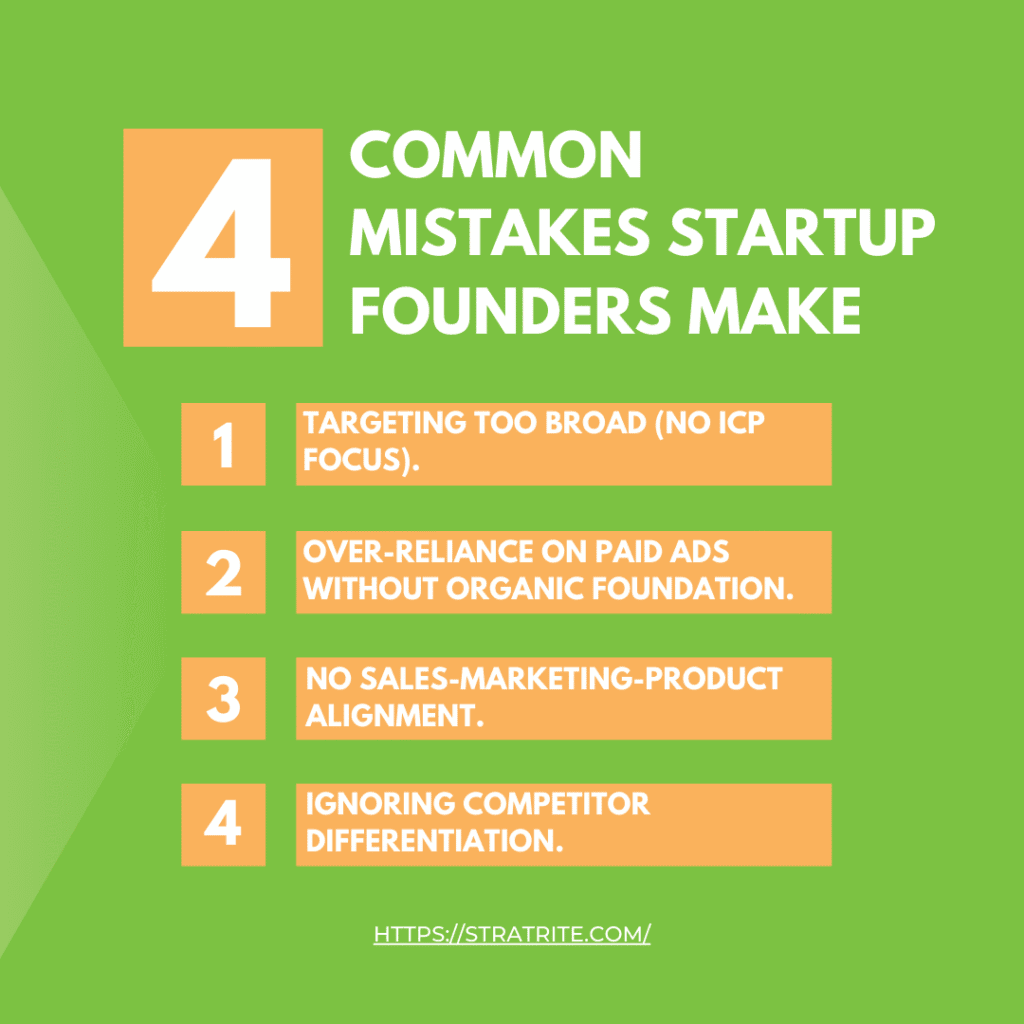
To Clarify..
When should a startup create its GTM strategy?
Ideally before product launch, however, it can (and should) evolve as the product scales.
How long does it take to implement a GTM strategy?
Typically 3–6 months to build and refine, with ongoing optimization.
Who owns GTM in a startup?
Founders usually lead GTM early on, with marketing and sales teams gradually taking ownership.
Final thoughts
A Go-To-Market strategy isn’t optional, it’s the blueprint for growth. By defining your ICP, mapping personas, sharpening positioning, choosing the right channels, aligning teams, and tracking metrics, you can turn your product launch into a scalable growth engine.
Remember: products don’t sell themselves. It’s your GTM strategy that ensures they get discovered, adopted, and loved
Frequently Asked Questions
What is a GTM strategy for SaaS startups?
A Go-To-Market (GTM) strategy is a step-by-step plan for how a SaaS startup introduces its product to the market, identifies the right customers, and creates a repeatable process to acquire and retain them. It covers ICP definition, positioning, pricing, channels, and metrics.
How is a GTM strategy different from a marketing strategy?
A marketing strategy is broader and ongoing, focusing on brand awareness, content, and campaigns across the customer lifecycle. A GTM strategy is specific to launching a product or entering a new market. GTM = the roadmap to launch, while marketing strategy = the ongoing playbook to grow.
What are the key steps in building a GTM plan?
The main steps include:
- Research your market & competitors.
- Define your Ideal Customer Profile (ICP) & buyer personas.
- Develop your Unique Value Proposition (UVP).
- Choose early acquisition channels (SEO, LinkedIn, email, etc.).
- Align sales & marketing collateral.
- Launch in phases (pilot → full scale).
- Measure KPIs (CAC, LTV, funnel conversion) and refine.
Do early-stage startups need a GTM framework?
Yes. Even bootstrapped or pre-Series A startups benefit from a GTM strategy. Without it, founders risk targeting too broad an audience, wasting budget on the wrong channels, and struggling to achieve product-market fit. A GTM framework provides clarity and focus from day one.
What is the role of ICP in GTM?
The Ideal Customer Profile (ICP) defines the type of company and decision-makers most likely to benefit from your product. In a GTM plan, ICP ensures marketing and sales efforts are targeted, messaging resonates, and campaigns generate qualified leads instead of wasted traffic.
How do you measure the success of a GTM strategy?
Success can be tracked through metrics such as:
- Customer Acquisition Cost (CAC)
- Lifetime Value (LTV)
- Conversion rates at each funnel stage (MQL→SQL→Closed Won)
- Churn & Retention rates
- Revenue growth in the first 90–180 days of launch.
Ready to launch with confidence?
Start building your GTM Plan today.